The corner around the church
Mount Morris Park, Harlem
A short guide to Mount Morris Park and its historic district in Harlem: the park, the cast-iron watchtower, the landmark rows and the domed church.
Book the Harlem gospel concert ↗Quick answer
Mount Morris Park, now Marcus Garvey Park, was set aside in 1839 and holds a cast-iron fire watchtower from the 1850s. The historic district around it, mostly late nineteenth- and early twentieth-century row houses and churches, became a city landmark in 1971.
The park
Wikipedia says Mount Morris Square was set aside on September 4, 1839. Wikipedia says the Mount Morris name for the rock formation is of nineteenth-century origin, though the origin of the Morris name itself is uncertain. It lies on the border of Harlem and East Harlem, between 120th and 124th Streets, and in 1973 it was renamed for Marcus Garvey, the leader of the Pan-African movement.
The watchtower
On a plateau at the centre of the park stands a fire watchtower, designed by Julius H. Kroehl and erected in the 1850s of cast iron. It is 47 feet tall and holds a 10,000-pound bell cast by Jones & Hitchcock. Wikipedia says it is the only one to survive of eleven such towers built in the city. It was designated a city landmark in 1967.
The historic district
Wikipedia dates the district's city landmark status to November 3, 1971 and its place on the National Register of Historic Places to February 6, 1973. Wikipedia describes it as mainly late nineteenth- and early twentieth-century row houses and church buildings, in a Gilded Age mix of Romanesque Revival, neo-Grec and Queen Anne styles. A boundary increase in 1996 widened the registered area, and the city landmark district was expanded in 2015.
The domed church
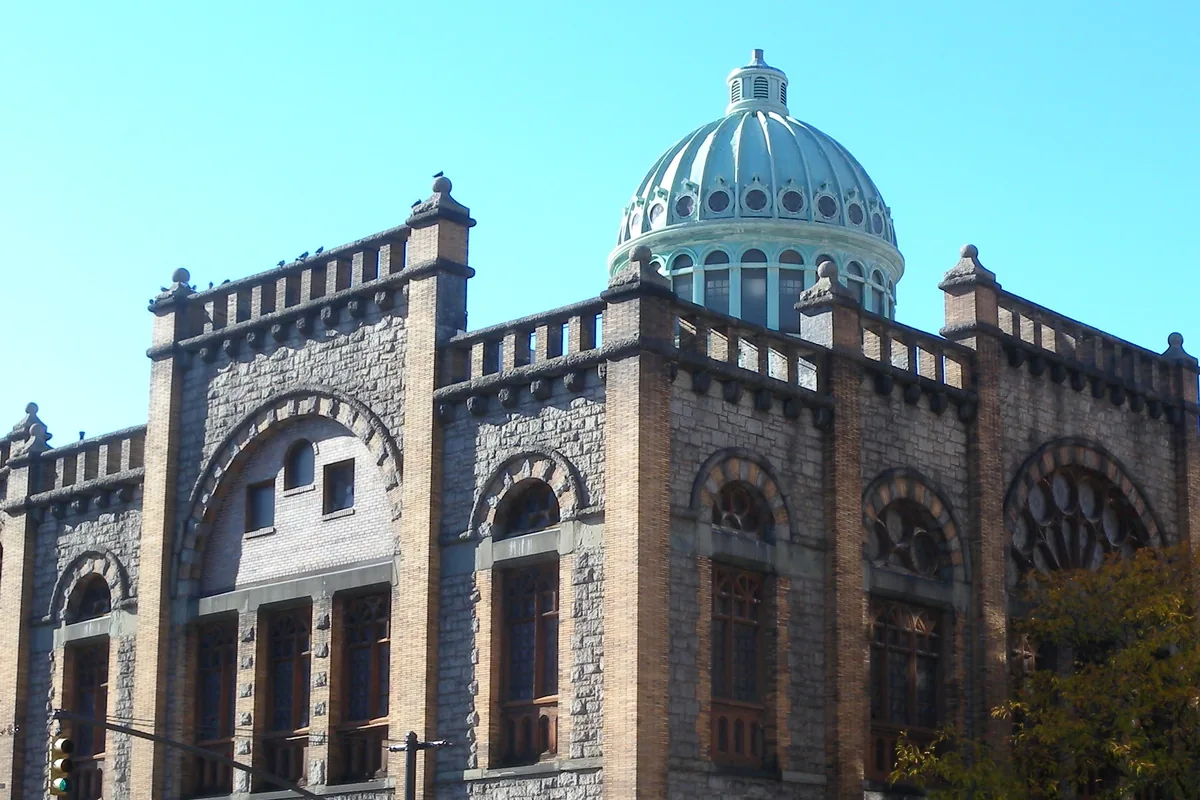
Mount Morris Ascension Presbyterian Church was designed by Thomas Henry Poole and completed in 1906, according to Wikipedia. It is built of granite and gold Roman brick, with a copper-clad dome and a patinated medallion of Noah's Ark above its doorway. An American Institute of Architects guidebook, Wikipedia notes, calls the dome above the building's eclectic architecture "just silly". The congregation was organised in the 1840s.
Music in the park
The park has its own stage: the Richard Rodgers Amphitheater sits on its west side, at 122nd Street. Doctor's Row, nearby, is placed by Wikipedia around West 122nd Street, Mount Morris Park West and Malcolm X Boulevard, and the article links it with the composer Richard Rodgers, whose father was one of its doctors. Music has long been part of the neighbourhood, inside and outside its churches.
Before the park was a park
Wikipedia says Native Americans used the rocky hill as a lookout over the island, and that during the Revolutionary War Hessian soldiers mounted a battery there. The nearby Little Hill was levelled when the right of way of the New York and Harlem Railroad was graded. The park was laid out in 1869 to a plan by the city surveyor Ignaz Pilat. The ground you walk across has served many uses.
A neighbourhood association
The Mount Morris Park Community Association, created in 1981, promotes the preservation of buildings in the neighbourhood and, Wikipedia says, holds annual Historic Neighbourhood House Tours in the second week of June. The Boys Choir of Harlem was established in the neighbourhood in 1968. Both are reminders that the streets around the church are lived in, not merely preserved, and that the neighbourhood has a long record of music and community work.
Who this isn't for
This is a corner to stroll, not a sightseeing programme. It will not suit anyone short of time: the concert takes an hour, and the park and district reward an unhurried walk afterwards. And it is a residential area, so keep voices down and respect the people who live and worship here.
Frequently asked questions
What was Marcus Garvey Park called before?
Mount Morris Park. It was renamed in 1973 for Marcus Garvey.
When was the watchtower built?
It was erected in the 1850s, of cast iron, and is the only one to survive of eleven built in the city.
Sources